Welcome!

Venice has 'captured' the heart, mind and imagination of so many writers, poets, artists and historians. Venice is one of my favourite subjects in art, literature and history, and I am always eager to learn more and look more at this unique and special place. This Venice blog is my way of collecting the wealth of images, poems, prose and impressions of Venice.
Showing posts with label Your first trip to Venice - a suggested itinerary. Show all posts

Sunday, 1 June 2014

Your first visit to Venice – a suggested itinerary Part 6

Your first visit to Venice - Part 1 Monday (day of arrival)
Your first visit to Venice - Part 2 Tuesday
Your first visit to Venice - Part 3 Wednesday 
Your first visit to Venice - Part 4 Thursday 
Your first visit to Venice - Part 5 Friday 

Part 6/ Day 6 - SATURDAY
The weekend will be the busiest in the city of your few days in Venice, and you’ll probably notice how much more difficult it will be to circulate around Venice, and if you go near the Piazza, how long the queues will be to enter the Palazzo Ducale and the Basilica di San Marco, in particular.  

I’d stay away from the Piazza between the hours of around 8.30am – 6pm during these few days.  Instead, take the opportunity to explore some of the less well-known parts of the city.

Rialto markets
Rise early today and catch the action at the famous Rialto markets. 

Traghetto
Now, take a traghetto trip across the Grand Canal from Rialto to the Santa Sofia stop.

The Grand Canal from a traghetto between Rialto and Santa Sofia
Ca d’Oro
Ca d’Oro is Venice’s finest Gothic building.  Its elaborate exterior is clad with white and coloured marbles (including red Verona marble).  Its window traceries and carvings used to be gilded, hence it’s name – the House of Gold.

Highlights of the collection are Mantegna’s St Sebastian, fresco fragments by Titian and Giorgione that used to decorate the Fondaco dei Tedeschi (formerly the main post office and now owned by Benetton and being converted into a large shop).

Be sure to enjoy the views on the balconies on the first and second floor, and the gorgeous courtyard with a beautiful well-head.


Balcony of the Ca d'Oro in Venice capturingvenice.blogspot.com
Second floor balcony of the Ca' d'Oro on the Grand Canal
Then, head by vaporetto to San Giorgio Maggiore. 

San Giorgio Maggiore
This Palladian complex of San Giorgio Maggiore includes a church, a campanile (which you should climb for magnificent views), and a monastery including cloisters, a refectory, library and garden.  It’s hard to believe that so much serenity can exist just a short hop across the water from the busy Piazza di San Marco.

Giardini Pubblici
Next, hop on a vaporetto and descend at Arsenale.  You could take a small detour to your right to peek inside the Giardini Pubblici – Napoleon razed this part of Venice to create these enormous gardens.  Beyond the public gardens are the gardens of the Biennale of art housing national pavilions of around 16 countries.  However, you can only access the Giardini della Biennale when the art and architecture biennales are being held.

Museo Storico Navale
Pop your head into Venice’s maritime museum to see a replica of the Doge’s ornate Bucintoro (the original was destroyed by the French when they conquered Venice).  My favourite exhibit is Peggy Guggenheim’s gondola.

Arsenale gates
Next, walk up to the gates of the Arsenale.  This area is still patrolled by the Italian Navy but you can stand at the Renaissance gates and gaze at the extraordinary trophies of war that protect its entry – two lions pillaged from near Athens in 1687 and another bald, upright lion with runic carvings.  He is thought to have been carved by Scandinavian mercenaries who in 1040 fought for the Byzantine empire.


Gates to the Arsenale Venice capturingvenice.blogspot.com
Gates to the Arsenale, Castello
La Pietà
Continue to walk along the Riva degli Schiavoni.  You’ll pass the Metropole hotel.  Turn right and walk a short distance between the Metropole hotel and La Pieta.  You’ll see the wall of the Metropole’s bar incorporates a foundling wheel, which allowed mothers to anonymously leave their children at the orphanage that used to operate on the site of the Metropole hotel.

Pop your head into the La Pietà, somewhat erroneously known as Vivaldi’s church - he worked as choirmaster at La Pietà from 1704-1740 and composed many works for the choir – but the present structure was built from 1745-1760 so Vivaldi never actually set foot inside this newer building.   The church is mostly used for concerts, and it’s well worth popping your head inside to see the 1755 ceiling by Tiepolo, Triumph of Faith.

San Zaccaria
We’ll change the pace at San Zaccaria with Bellini’s Madonna with Child and Saints, some 15th century frescoes by Vivarini and an atmospheric and slightly eerie waterlogged crypt where eight doges are buried.

For things to do tonight, please refer to my suggestions from yesterday’s itinerary.

Your first visit to Venice - Part 7 Sunday

Monday, 26 May 2014

Your first visit to Venice – a suggested itinerary Part 5

Your first visit to Venice - Part 1 Monday (day of arrival)
Your first visit to Venice - Part 2 Tuesday
Your first visit to Venice - Part 3 Wednesday 
Your first visit to Venice - Part 4 Thursday 

Part 5/ Day 5 - FRIDAY

You’ll notice today that the build up of day trippers and weekenders is increasing as we approach the weekend.  It’s a good day to get out to some of the islands of the Venetian lagoon. 

The first time I went to Venice, Murano, Burano and Torcello were still fairly sleepy places with little infrastructure for tourists.  On my last visit, I was surprised how much development has taken place, even in Torcello. You have to experience the Venetian lagoon to appreciate the magnitude of the achievement of Venice.  As your vaporetto motors north, consider how the security of the Venetian Republic relied on the difficulty of navigating its shallow lagoon waters.  Look out for the many deserted and derelict islands that you’ll pass, many of them now subsiding into the lagoon.


Vaporetto in the Venetian lagoon capturingvenice.blogspot.com
Contemplating the Venetian lagoon on a cold morning on an empty vaporetto
This is how Venice started.  All the sites that you’ve seen this week – the Doge’s Palace, the enormous campanile that you climbed, Tintoretto’s amazing cycle of paintings at San Rocco, the vast golden interior of the Basilica di San Marco, those stunning palazzi lining the Grand Canal – they all grew from marshy islands just like these. 

Consider how desperate the first settlers of Venice must have been to choose this place as their home, and how clever, inventive and persistent they must have been to do more than survive on fishing and trade in salt.

As you journey in the lagoon, remember that by 16th century, the Venetian Republic – the Queen of the Adriatic – held a monopoly on Mediterranean trade and colonised the whole of the north-east of modern day Italy, from the Adriatic to the Alps.  The Republic commanded colonies and Venetian settlements as far away as Alexandria and Constantinople, as well as Cyprus, Candia, Dalmatia and Istria. 

And it all grew from this lagoon.

I would start the day as early as possible by walking to Fondamente Nuove to catch the vaporetto to these northern islands.  (If you walk to Fondamente Nuove via Campo SS Giovanni e Paolo (in dialect: San Zanipolo), you can take the opportunity to grab a warm brioche and cappuccino at Rosa Salva).

The vaporetto will call at stops on Murano, Burano and Torcello.  I would head directly to Torcello, and hop off at Burano and Murano on the way back to Venice.

Torcello
Torcello is one of my personal favourite places in Venice.  First settled in the 5th century, it became the seat of the bishop of Altinum in 638 and in 639 its cathedral, Santa Maria dell’Assunta was founded.  By the 14th century, Torcello was home to 20,000 residents, but its canals were beginning to silt up and malaria ensued. By the end of the 15th century, the island was mostly deserted and today only a handful of people live here.

Your first stop (after the souvenir and coffee cart) will be the church of Santa Fosca.  I love the bare, elegant interior of this place, built in the 11th and 12th centuries.  The first time that I ever experienced absolutely serenity and silence was in the quiet atmosphere of Santa Fosca.

Interior of Santa Fosca church, Torcello Venice capturingvenice.blogspot.com
Interior of Santa Fosca, Torcello
Most of the cathedral dates from the 11th century and with its wall and floor mosaics in the Byzantine style, its interior is extraordinary. 

The small Museo di Torcello is also worth a quick look to see some of the archaeological relics including ceramics, jewellery and mosaic fragments.

Burano
Next, hop back on the vaporetto toward Burano, famous for its colourfully painted houses and (lost) ancient lace-making traditions.  It’s still largely a fishing village, and it’s interesting to look at the fishing nets and boats lining the canals.  You can also visit the Scuola del Merletto (lace school), which opened in 1872 when lace-making skills on the island had declined to the extent that just was woman was available to pass on her skills and knowledge to the next generation.  Sadly, the school has not run regular courses since the 1960s, although you can view displays of traditional lace-making techniques.  There is also a painting by Tiepolo in the island’s sole church, San Martino.

Murano
Everyone knows that Murano means glass. Today, Murano is the city’s sole surviving manufacturing area and the island seems to be covered in glass souvenir shops.  If you’re there at 10am, I would make a bee-line for the Museo del Vetro (it opens at 10am) – the collection is absorbing, as well as the technical displays of glass-making techniques.  If you’re too early for the museum, head straight to Santi Maria e Donato, a beautiful 12th century church.  Its mosaic floor is unforgettable.


Approach to Murano by vaporetto - look at all the glass foundries coming into view
Now it’s time to head back to Venice.  As the vaporetto nears Fondamente Nuove, you’ll again pass the cemetery island of San Michele.  If you are interested, and have the time, you could hop off here to find the graves of well-known foreigners in the Protestant section including Diaghilev (whose graves often has ballet slippers left by admirers) and Stravinsky.


Approach to San Michele from Murano to Fondamente Nuove
San Zanipolo
At Fondamente Nuove, hop off and head to SS Giovanni e Paolo (or as it’s known in Venetian – San Zanipolo).  A Gothic, Dominican church, it’s huge interior contains the tombs of many past Doges.  I particularly love Piazzetta’s St Dominic in Glory ceiling in the Capella di San Domenico. There is also a 15th century Murano stained glass window in the south transept – a rare opportunity to see stained glass in Venice.

Colleoni monument
This gorgeous equestrian statue of condottiere Bartolomeo Colleoni is one of my favourites in Venice.  Set high up on a pedestal, it was begun by Florentine Andrea Verrochio and completed by Leopoardi following Verocchio’s death. I love the dynamism and power of the horse.


Monument to Colleoni in Venice capturingvenice.blogspot.com
Monument to condottiere Bartolomeo Colleoni in Campo SS Giovanni e Paolo, Castello
Scuola di San Marco
The restored interior of the Scuola (whose facade and foyer now form part of Venice’s hospital) opened in late 2013.  I’ve never been, so if you get there, please send me a photo and your review!!

Palazzo Querini della Stampalia
Next, walk toward Campo Santa Maria della Formosa.  It’s a huge, bustling campo filled with local shops, some hotels, fruit vendors and a newsstand and tucked into a corner, is the Palazzo Querini-Stampalia with its picture gallery and lovely ground-floor rooms and garden by Venetian architect, Carlo Scarpa.

Palazzo Grimani
It’s worth stepping into the Palazzo Grimani for its impressive interiors.  

Calle del Paradiso
Finally, if you walk back towards Rialto, take the Calle del Paradiso – a gorgeous Gothic street with a 15th-century arch at one end depicting the Madonna sheltering two people.  The arch commemorates the marriage of Alvise Mocenigo and Pellegrina Foscari, whose dowry included 26 houses in this street.  Look up at to see the barbacane – clever devices to extend living space within the houses.


Calle del Paradiso in Venice capturingvenice.blogspot.com
Calle del Paradiso in Venice - look at the barbacane hanging overhead
There’s a fabulous bookstore, Filippi Editore on this street, which specialises in titles on Venice in both English and Italian.

Tonight would be a good evening to wander through the streets of Venice – perhaps to return to some of the places that you’ve explored during the day in the past week, and see what they look like at night.  

Or, you could take a walk to the Piazzetta to enjoy that quintessential view across the Grand Canal toward the Punta della Dogana and San Giorgio Maggiore, and then stroll down the Riva degli Schiavoni enjoying the view.

You could also take the opportunity to go to one of the many concerts that are always advertised on billboards throughout the city – as a bonus, this will also give you the chance to get inside some of the fabulous concert spaces in the city from the opera house, La Fenice to the churches of San Vidal, La Pieta, the Ospadeletto etc.  

If the weather is fine, you could also splash out on a meal or post-dinner drinks at one of the many bars with gobsmacking views including the top of the Hotel Danieli, the balcony of the Gritti Palace, or the Monaco e Grand.  If you loved Caffe Florian, you could return there.


Caffe Florian capturingvenice.blogspot.com
Drinks at Caffe Florian Venice
If you prefer something rowdier (and cheaper), you could also head to Campo Santa Margherita which will be pumping with university students having a night out. 

Monday, 19 May 2014

Your first visit to Venice – a suggested itinerary - Part 4

Your first visit to Venice - Part 1 Monday (day of arrival)
Your first visit to Venice - Part 2 Tuesday
Your first visit to Venice - Part 3 Wednesday 

Part 4/ Day 4 - THURSDAY

Today, I’m going to show you through Venice’s remaining scuole.

In Venice, a system of charitable and religious institutions were formed from the early 13th-century.  By the middle of the 16th century there were five more major Scuole – San Giovanni Evangelista, San Marco, Santa Maria della Misericordia, San Rocco and San Teodoro, as well as around 400 other smaller institutions that were united by membership of certain guilds or nationalities.

All of the scuole provided financial and medical assistance to their members, offered a place for worship and provided support in times of emergency including plague epidemics.

The paying members of the major Scuole came from the wealthiest trades and professionals (doctors, lawyers, civil servants) in the city, and the wealth of these major institutions is demonstrated by their rich architecture and sumptuous commissions of devotional artworks.

Napoleon banned the scuole in 1806. 

Many of their treasures were dispersed (you saw some of them yesterday at the Accademia Gallery) and others were given new uses such as the city hospital.  A small number of the scuole were revived in the 19th century – the Scuola San Giorgio degli Schiavoni and Scuola Grande di San Rocco now continue to function as charitable bodies in their magnificent head quarters, and the San Giovanni Evangelista was re-instituted in the 20th century.

I recommend that you devote your fourth day in Venice to seeing the major scuole that are still open to the public, as well as monuments and nearby churches.  You will be covering alot of ground today, and seeing a huge amount of magnificent artworks.  Today’s proposed schedule is ambitious and demanding.  I recommend that you have a hearty breakfast today and pack some snacks or plan to simply grab a quick snack somewhere so you can maximise your viewing hours.  I promise that you’re in for a rare series of visual treats, and I promise that I’ll reward you with good wine and food at the end of the day.

Are you ready?  Here we go:

Scuola di San Giorgio degli Schiavoni in Castello
Arrive at 10am, when this small, unassuming building opens to the public to reveal an extraordinary series of paintings by Carpaccio.  I’ve written about this scuola in a previous post, which you can read here.  I hope you’ll walk away charmed and warmed by the humanity and beauty of Carpaccio’s work.  Allow about 20-30 minutes here.

Note that the Scuola di San Marco (now part of the city hospital) is about a 15 or 20-minute walk away from where you are now.  I haven’t actually seen this place – it was conserved and re-opened just a few months after my last visit to Venice in late 2013.  As you’ll be nearby in tomorrow’s itinerary, I recommend seeing this scuola on another day. 

Scuola di San Giovanni Evangelista
Next, take a vaporetto San Toma and strike out into the heart of the San Polo district to find the Scuola di San Giovanni Evangelista which was re-established in 1929.  You can admire the 1481 screen of the outdoor courtyard by Pietro Lombardo.  You could if you wish, also go inside to see a relic of the ‘True Cross; in the first floor oratory.
Allow about 10 minutes here.
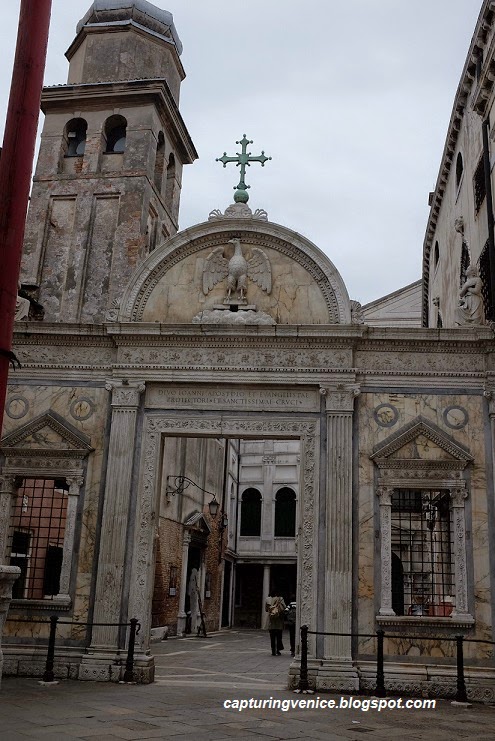
Scuola di San Giovanni Evangelista Venice capturingvenice.blogspot.com
Gates to the Scuola San Giovanni Evangelista
Chiesa dei Frari  
This is the magnificent Gothic church built by the Franciscans from the 14th century.  The huge, bare brick exterior belies the beauty within.  Please refer to your guidebook for a full description of the treasures within this church. 


Entry to the Frari church, Venice capturingvenice.blogspot.com
Entry to the Frari church
My personal favourites are Titian’s Assumption on the high altar and Madonna di Ca’ Pesaro, the 15th century monks choir by Bartolomeo Bon and Pieto Lombardo, the strangely compelling and slightly frightening tomb of Doge Giovanni Pesaro and the pyramidal Mausoleum of Canova (1827) with its heartbreakingly sad grieving lion.

There is so much beauty and interest in this one church. I’ve spent many happy, contemplative hours here wandering around, absorbed in Titian’s Assumption through a mass service or during one of the many concerts held here. 

I’m finding it hard to advise you how much time to allow here – an hour or a lifetime?

Scuola Grande di San Rocco
At some stage, you’ll have to tear yourself away from the Frari, and can you believe – even more astonishing things await you, just around the corner.

As you approach Campo San Rocco, you will be greeted by two sumptuous, white facades.  On your left, is the side of the Scuola Grande di San Rocco and directly ahead of you is the Chiesa di San Rocco.  If you’ve never seen a painting by Tintoretto until now – you are in for wild ride.

This Scuola was founded in 1478 and its patron saint is St Roch (Rocco) of Montpellier who left his home to work with victims of the plague.  In 1483, San Rocco’s remains were brought from Germany to Venice, which resulted in a boom in donations to the scuola and allowed its elevation to the status of ‘Scuola Grande’.  In 1527, Venice suffered a plague epidemic and the coffers of the scuola grande filled rapidly as the citizens of Venice sent in donations, in the hope of being protected from the ravages of the plague.  The scuola’s social prestige and financial security were secured and the members soon embarked on a building project to create their present headquarters. In 1564, the scuola asked four artists – Salviati, Zuccari, Veronese and Tintoretto (1519 – 1594) – to submit sketches for the first painting for the building with the theme of The Glorification of San Rocco.

Tintoretto sneakily won the competition – whilst his rivals presented their sketches, Tintoretto had painted an entire panel and persuaded someone to rig it up in the upper floor Sala dell’Albergo, in the place where the winning painting would be installed.  Ta da!

His painting was revealed and he offered it as a gift to the Scuola.  A by-law of the Scuola stipulated that no gift could be rejected – and Tintoretto won the competition.  He completed the other decorations of the same ceiling for free.

What you see around you is the most comprehensive collection of work by Tintoretto in the world.  In November 1577, he offered to provide the Scuola with three paintings per annum for 100 ducats -  today, you can see 52 paintings by Tintoretto around you.

The scuola provides large mirrors to help you as you walk around the upper floor marvelling at Tintoretto’s wildly emotional paintings.  I always really love the trompe l’oeil library carved into the wood of the walls by Francesco Pianta in the 17th century.  Displayed on easels at the front of the room are some works by Titian and Tiepolo, and you can also climb to the top floor to see the scuola’s treasury of gold and silver devotional and liturgical objects.

As you exit the Scuola, stop for a moment to look around the salmon pink walls of the Scuola and the serenity of the canal.  This is one of my most special places in Venice, and John Singer Sargent loved it too.   

Chiesa di San Rocco
I hope you’ve not yet had your fill of Tintoretto.  Right next door to the scuola is the Church of San Rocco where you can see another six of his paintings.

Tonolo pasticceria
I think it will be around 2.30pm and I think you need some sugar and caffeine. Pop into the nearby Tonolo pasticceria in the Crosera San Pantalon (it’s just a couple of minutes away and on our way to the next destination) for an astonishingly excellent coffee and pastry. 

Keep walking to Campo San Pantalon, cross the bridge into Campo Santa Margherita and walk through to its south-west end to the Scuola Grande dei Carmini. 

You will want to be distracted by gelato, by the many bars and cafes, by the best takeaway pizza place in Venice. 

KEEP GOING.  I promise you your fill of goodies later. 

Scuola Grande dei Carmini
I bet you’re feeling tired, maybe a bit grumpy, and definitely foot sore by now.  Well, climb the stairs to the top floor of this scuola to take relief in Tiepolo’s lovely ceiling panel showing Simon Stock receiving the scapular, painted for the Carmelites in the 1740s.

To Campo San Barnaba
Next, walk along the edge of Campo Santa Margherita, find the gelato shop Il Doge (it’s immediately opposite the supermarket) and get yourself a big scoop of ice-cream. 

You jolly well deserve it.  You’ve been so patient and you’ve done so much already.  Enjoy your hit of sugar because there’s more to come.

Next, you’ll walk across the Ponte dei Pugni (Bridge of the Fists) where you’ll find marble footprints showing the starting positions for fights that used to take place.  The traditional brawls were banned in 1705. Alongside the Ponte dei Pugni is the famous vegetable boat.

Ca' Rezzonico
Your final stop for the day is the museum of the eighteenth-century Venice, Ca’ Rezzonico.
This museum will give you a fantastic sense of what an 18th century palazzo interior would have looked like, and its collection highlights some fascinating objects and paintings from that era.  

Exterior of Ca' Rezzonico, Venice capturingvenice.blogspot.com
Exterior of Ca' Rezzonico
Dinner
OK, I promised you some great wine and food tonight.

If you liked the look of Campo Santa Margherita, head back there. 

By evening, it will be full of students and young families enjoying drinks and food in its many bars, pizzerie and osterie.   

I would start at the little bar on the campo San Pantalon side of the campo for a drink and a snack.  You could then carry onto Caffe Rosso for more drinks and snacks, finishing at one of the restaurants, pizzerie or cafes for your meal.  My personal pick is Osteria alla Bifora on the Carmini side of the campo.  If you didn’t go to Il Doge earlier for gelato, now’s your chance. 

If you’d like to see something different, and are prepared to pay just a little bit extra for your meal, you could try one of the many restaurants that line the Calle Lunga San Barnaba, which is on the other side of the canal from Ca’ Rezzonico.  My picks here would be: Ai Quattro Ferri, La Bitta or Pane, Vino e San Daniele which is now part of a chain.

The gelato chain, Grom is right near the church.

You could also duck under the sottoportego leading out of Campo San Barnaba to find several more restaurants on the Fondamente della Toletta including the long-standing Ai Artisti.

To round off your evening, if I were with you, I’d take you on a vaporetto ride up or down the Grand Canal from the stop at Ca’ Rezzonico to enjoy looking up from the water at the palazzi lit up at night.  

Your first visit to Venice - Part 5 - Friday

capturingvenice.blogspot.com palazzo on Grand Canal, Venice


Saturday, 10 May 2014

Your first visit to Venice – a suggested itinerary Part 3

Your first visit to Venice - Part 1 Monday (day of arrival)
Your first visit to Venice - Part 2 Tuesday

Part 3/ Day 3 - WEDNESDAY

Again, as it’s the middle of the week, I recommend that you use today to visit Venice’s busiest art museums – the Accademia Gallery, the Peggy Guggenheim Collection and the Punta della Dogana.

Accademia Gallery
I would start with the historic picture collection of the Accademia Gallery to view the world’s foremost collection of Venetian art.  

When Napoleon captured Venice in 1797, he suppressed its churches, convents and monasteries and much of these institutions’ artworks fortunately wound up here, in the Accademia. 

Even the buildings housing the Accademia were originally the church of Santa Maria della Carità, the Convento dei Canonici Laterenensi and the Scuola della Carità.

As you walk around, it’s fascinating to read the labels and find out where each of the works were originally located in Venice.  Photography is prohibited within the gallery, so I can't show you any images.  Some highlights are:
  •  Veronese’s enormous Christ in the House of Levi (originally from the refectory of the church of SS Giovanni e Paolo – the church still exists, but the refectory is now part of the city’s hospital)
  • Tintoretto’s St Mark Freeing a Slave from the Scuola di San Marco (also now part of the city’s hospital)
  •  Carpaccio’s Story of St Ursula, painted for the Scuola di Sant’ Orsola 
  • Lovely fragments of a ceiling that the 18th-century painter Giambattista Tiepolo painted for the Scalzi church, which was bombed by Austrians in 1915.  The restored church still stands near the railway station.
  • The cycle of the Miracle of the True Cross painted from 1494-1501 for the Scuola Grande di San Giovanni Evangelista (this scuola still exists and you’ll get to see it later in the week).
One of the few works in this collection that is still exhibited in the place for which it was painted is Titian’s Presentation of the Virgin (1539), on the wall above the door of the former albergo of the scuola.

Next stop is lunch, and I highly recommend a little bar called Da Gino which is on the main drag toward the Peggy Guggenheim Collection. 

Lunch at Da Gino
Please order a tramezzino sandwich.  You’ll never forget your first taste of a tonno e ouva tramezzino from Da Gino.  I always love to bring friends and family here, order them this tramezzino and then watch their faces as they take their first bite. 

Wash it down with a glass of Prosecco.  Finish it off with a restorative espresso or macchiato.

Feeling refreshed?  Great.  Let’s set off for the Peggy Guggenheim Collection.

Peggy Guggenheim Collection
Peggy moved to Venice 1949 and lived here at the Palazzo Venier dei Leoni until her death in 1979.  She brought to Venice her wonderful collection of 20th century art including works by Picasso, Braque, Chagall, Pollock, Giacometti, Magritte and her husband, Max Ernst.  It’s a small but wonderful collection, and a delightful museum.  I’ve written about the Peggy Guggenheim Collection in other posts in this blog, and you can find links to past articles here:

Please say hello to Marino Marini’s wonderful Angel of the Citadel for me.  Please lean against the balustrade of the balcony and please say hello to that view of the Grand Canal for me.


Marino Marini sculpture at Peggy Guggeneheim Collection Venice capturingvenice.blogspot.com
Angel of the Citadel, Marino Marini at the Peggy Guggenheim Collection, Venice
Then, please step into the cafe and enjoy a coffee or another prosecco for me, and then visit the gift shop and support the museum with several purchases.

Punta della Dogana
Now, race over to the Punta della Dogana (the former customs house), which since 2009 has been Francois Pinault’s Centro d’Arte Contemporanea, a gorgeous exhibition space created by Japanese architect Tadao Ando and showcasing a rotating range of terrific exhibitions of contemporary work.  Pinault also owns the fabulous Palazzo Grassi, also an exhibition space for contemporary work, which is located on the other side of the Grand Canal near the San Samuele vaporetto stop.

If you haven’t yet seen the inside the Salute, you should also take the opportunity to do this now.


La Salute church Venice capturingvenice.blogspot.com
Exterior of the Salute 
The Zattere/ Gesuati
Continue along the Zattere – a wide, long scenic walk along the edge of the sestiere of Dorsoduro with views across the wide Giudecca canal to the islands of the Giudecca and San Giorgio Maggiore.  Your first stop along the Zattere  is the Gesuati church to see Tiepolo’s magnificent ceiling panel, Scenes from the life of St Dominic.

There are some nice bars along the way to stop and have a drink or Gelateria Nico is famous for its gelato and gianduia ice cream.  Not far away is the scenic squero di San Trovaso, the oldest gondola yard still in operation.  Nearby is the bar, Cantinone Storico, famous for its wines and cichetti (delicious tit bits to be consumed with a small tipple of local wine).

La Giudecca
From here, walk back to the Zattere to catch a vaporetto across to the Giudecca.  It’s only a short hop away.  Take a walk around this largely residential area.  The city’s wealthiest nobles used to build their villas here, until the Brenta River became prestigious in the 17th-century.  From the 19th-century, many areas of the Giudecca were transformed by industry including an asphalt factory, a distillery, the Junghans clock and watch factory, Fortuny’s textile factory (which still operates here), and the enormous and imposing neo-Gothic Mulino Stucky flour mill, which closed in 1954 and became the Molino Stucky Hilton in 2003.  It has the city’s only rooftop pool and a great roof-top bar with excellent views.

Once on the Giudecca, poke your head into that grand Palladian church, Il Redentore.  I love the serenity and elegance of its interior. 

You could have dinner at La Palanca, to enjoy the view across to the Zattere, and then a night-cap at the roof top bar of the Hilton.

Click here to read 'Your first visit to Venice - a suggested itinerary Part 4/Day 4'

Tuesday, 6 May 2014

Your first visit to Venice – a suggested itinerary Part 2


Part 2/ Day 2 - TUESDAY

Open your eyes as early as you possibly can.  You’re in Venice; you don’t want to miss a minute of this magic lolling about in the dark of a hotel room (unless it’s a particularly beautiful hotel room, or you have a wonderful view, in which case, who am I to argue?).

Get out in the city, smell the freshness of the morning and enjoy a moment in Venice before the rush of day-trippers storm the city. 

Find somewhere for a fresh, warm pastry straight from the warmer and an excellent, stirring cup of coffee. 

Today is your day to orient yourself to Venice, so let’s start from the beginning and head straight to the Piazza San Marco. 

The weekend and long-weekend visitors will have departed, so this is your best day to experience the sights in the Piazza San Marco.

Campanile and Palazzo Ducale of Piazza San Marco capturingvenice.blogspot.com
The Campanile and Palazzo Ducale seen from the water 
Campanile
Be one of the first to queue for the ascent in the campanile.  A lift will take you directly to the summit.  You have as much time as you wish to take in the view to the south across the Grand Canal to San Giorgio Maggiore and north looking across the sestiere of Castello.  To the north-west is the sestiere of Cannareggio and to the east you will see the eastern Castello and in the distance, that engine room of Venetian power and trade, the Arsenale.

Palazzo Ducale
Next, go to the Palazzo Ducale.  Allow at least two hours to see this magnificent place, built to impress and intimidate visitors and citizens of the Republic of Venice. 


Palazzo Ducale Venice capturingvenice.blogspot.com
Palazzo Ducale 
Please don’t miss the prisons underneath the building.  I also highly recommend the ‘Secret Itineraries’ tour which you have to pre-book and which will allow you to access the ‘piombi’ (lead) prisons under the roof of the building, from which Casanova famously made his escape.

There is an excellent souvenir shop as you exit the building, with a great range of Venice-related books and attractive souvenirs.

Museo Correr
You must surely be parched and hungry (as well as a bit footsore) by now.  If you can, please keep walking just a little bit further, straight across the Piazza to the Museo Correr.

Here, you can enjoy the quiet café overlooking the Piazza San Marco, with rich decorations in the Empire style and comfy armchairs. 

Fortified?  Excellent.  Let’s continue.

Allow at least an hour to look around the vast Museo Correr with its recently restored Royal Apartments, gallery of sculptures by Canova, picture gallery including Jacopo de’Barbari’s astonishing aerial view of Venice engraved in 1500 (and displayed with the original wood blocks) as well as Carpaccio’s famous painting that was once known as The Courtesans, the civic archaeology collection and the main hall of the Libereria Sansoviniana.

You might need another pit stop for a break and refreshment when you leave the Museo Correr.  You might want to return to Caffe Florian, or, alternately, you can try Caffe Quadri (it’s older than Caffe Florian but it isn’t as pretty) or the Café Lavena. 

Basilica di San Marco
Hopefully by now the queue to enter the Basilica di San Marco is lessening, so jump in there. 
The first time that I ever stepped inside the Basilica, I was astonished and humbled by the magnificence of the sombre, ancient interior.  I encourage you to pay the admission fee to view the Pala d’Oro, the treasury and the  Loggia dei Cavalli, where you can see the original, famous bronze ‘Horses of Saint Mark’s’, an ancient quadriga that was looted from Constantinople by the Venetians in 1204.  Then you can step outside onto the balcony to see the replica horses which now stand in their place and take in the view over the Piazza.

By this time, the monuments and museums of Venice are probably closing and the next thing that I encourage you to do is to take a gondola ride.


The Horses of Basilica di san Marco Venice capturingvenice.blogspot.com
The Horses of San Marco - seen from the outside of the basilica (these are the replica horeses)

Gondola ride
You heard me correctly, TAKE A GONDOLA RIDE!  Don’t leave Venice without doing this!  But make sure that you ask your gondolier to take you around the quieter parts of Venice – if you’re just going to experience the gondola on the Grand Canal, you may as well take a vaporetto!

It’s easy to forget that since the late 19th century/ early 20th century, Venice has been extensively pedestrianized.  The main pedestrian thoroughfares, the Via Garibaldi and Strade Nuova were created in the early 19th century by filling in canals.  Every time you see the sign ‘Rio Terra xxx”, you are walking on a former canal.

The buildings of Venice were built to be seen from the water, and even the tiniest amount of navigating the city from a gondola will give you a sense of the city as it was meant to be traversed – by water. 


As well, you’ll be able to observe at close quarters the skill and experience of Venice’s gondoliers – it’s extraordinary to watch their graceful, powerful movements as they steer and move their elegant gondolas around heavy traffic, parked boats and around tight corners and under low bridges.  Please don’t miss this experience.

Click here to read Your first visit to Venice - Part 3/ Day 3